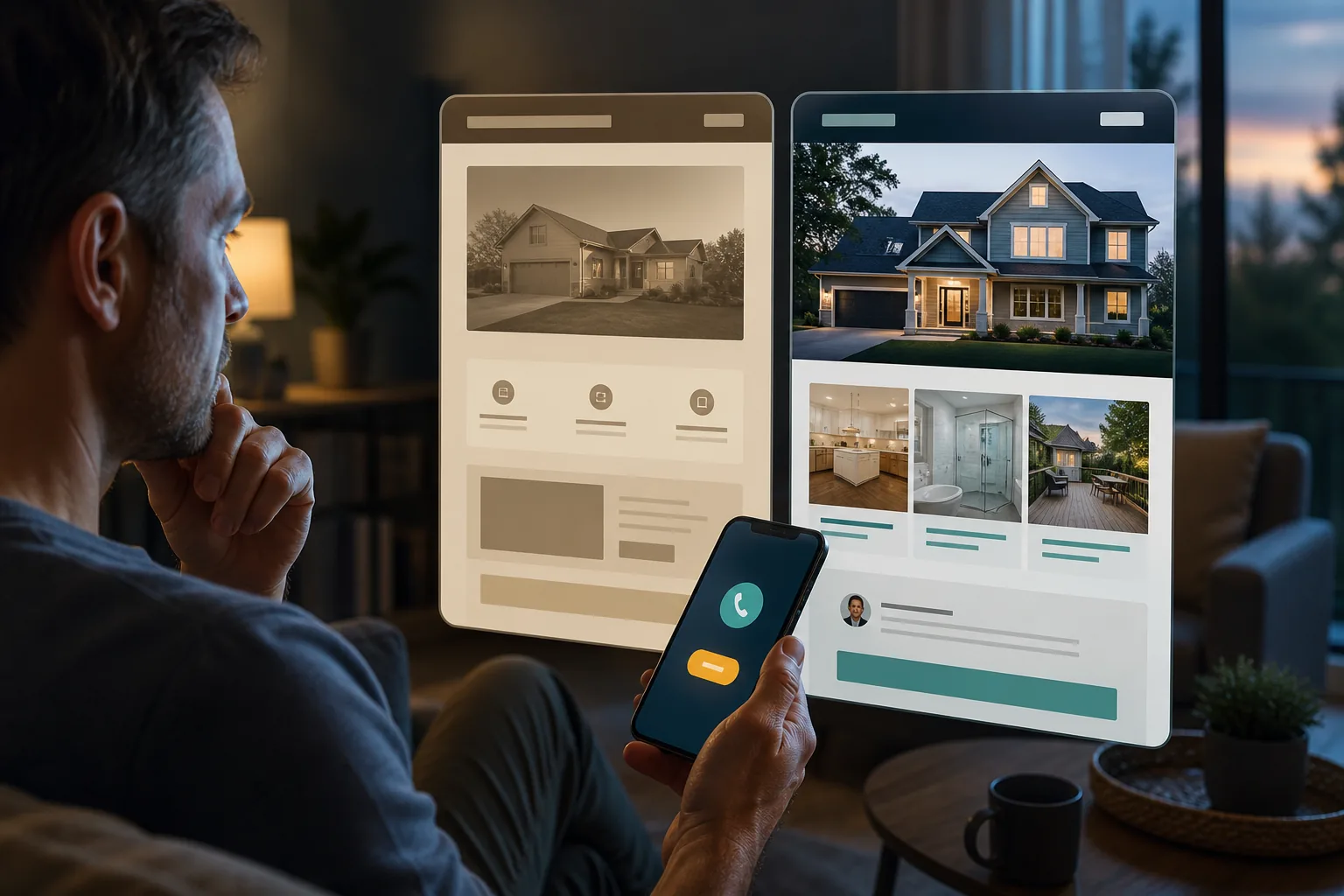
The trust gap: why service businesses get visits but not calls
By Milad Nikaeen | 7 min read | August 18, 2026
Someone found you. They read a review. They opened the site. Then they hired the shop that looked like a decision, not a template.
That is the trust gap. Traffic is not the win. A booked job is. If you already ran the three-leak test in Why your marketing isn’t working and the answer was “people visit and leave,” this is the article for that leak. If nobody visits in the first place, start with the Maps listing: why your Google Business Profile isn’t showing.
The proof: reviews start the job. Your site has to finish it.
BrightLocal’s Local Consumer Review Survey 2026 (US consumers) found 97% still read reviews for local businesses. After a positive review, though, most people do not book on the spot. 66% keep researching. 54% go to the business website — up from 32% when BrightLocal last asked in 2019.
That website is where many North American service businesses drop the lead. In BrightLocal’s SMB Marketing Report 2025 (778 US owners), 89% said they invest in organic SEO, yet only 40% have a dedicated business website. Only 35% said they have a Google Business Profile. Reviews send people somewhere. Too often there is nowhere solid to land.
People trust people more than ads
Nielsen’s 2021 Trust in Advertising Study (40,000+ consumers worldwide) found recommendations from people they know are the most trusted channel — about 88–89%. Trust in advertising was lowest in North America and Europe. Paid social and banners sit at the bottom of that list. If your site looks like an ad and not like a real operator, you are asking a skeptical market to take a leap.
Local Impact’s 2025 US local-business survey ranked standing out from competitors (20%) right behind budget as a top marketing challenge. That is a trust and positioning problem, not a media-buying problem.
What a trust gap looks like on a real homepage
You do not need a heat map to see it. A stranger should be able to answer four questions in ten seconds:
- What do you actually do?
- Who is this for (and who is it not for)?
- Why you instead of the cheaper option?
- What do I do next?
If the answers are “services,” “everyone,” “quality,” and five competing buttons, you have a trust gap. Ads will only buy more of that confusion.
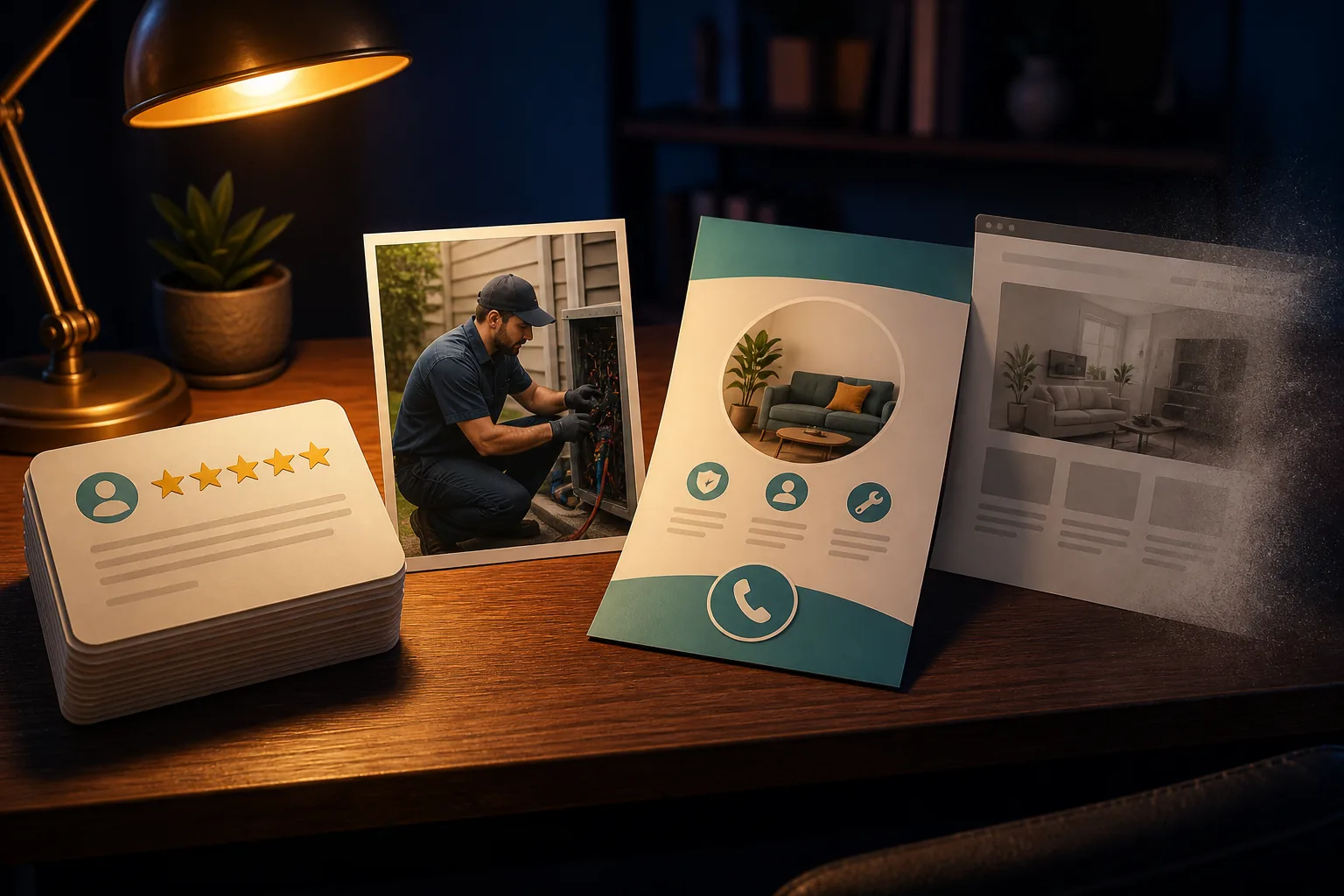
1. The offer is a list, not a point of view
“Plumbing, heating, drains, commercial, residential” is a directory entry. It is not a reason to pick you. Brand Strategy is the sentence that says who you help and what you refuse — so Google, ads, and the homepage stop attracting the wrong town and the wrong budget.
2. The proof is missing or looks stock
BrightLocal’s 2026 survey also found 85% are more likely to use a business after positive reviews, and 77% are deterred by negative ones. Video and photos of the actual crew, the actual job, the actual neighbourhood beat a hero image from a stock library. That is Creative Production: design and video that explain value, not decoration. We wrote the stills playbook here: stock photos aren’t proof. The motion playbook is Stop wasting money on pretty videos. If you want the sequence without guessing, take the five-step growth plan.
3. Reviews exist. You never answer them.
Google’s own help for managing customer reviews is simple: a public reply shows you value the feedback. BrightLocal notes that slow or generic replies now read as a red flag. Google’s official walkthrough:
Google Business Profile Help — how to read and reply to reviews (watch on YouTube)
4. They inquired — and waited
Trust is also speed. If the form works and nobody answers, the site did its job and the operations leaked. That is WealSmart CRM and the playbook in The 5-Minute Rule. A ChatGPT caption is not that job — ChatGPT is not an AI agent. The five-step growth plan picks the leak.
Fix the page before you buy more clicks
- Rewrite the first screen as one offer, one audience, one action.
- Put proof above the fold — recent reviews, real photos, service area.
- Match the ad or Maps listing to a specific service page, not a generic About.
- Reply to Google reviews as the business, not as a template.
- Then take the growth plan so the next dollar goes to the right leak.
HubSpot’s roundup of local SEO stats still points to the same behaviour: people who search locally are trying to contact someone. A mobile-friendly, clear site is how that contact happens. Nielsen’s research is the warning label: North American buyers already distrust ads. Do not make the website feel like another one.
If you want the sequence without guessing, use the five-step growth plan on the homepage. It takes a few minutes. It maps your answers to Brand Strategy, Creative Production, or WealSmart CRM.
FAQ
Why do people visit and not call?
They are still researching. BrightLocal found most people keep looking after a good review. The website has to finish the argument.
Are Google reviews enough?
No. They are the handshake. The site is the conversation. Fifty-four percent go to the website next.
What should I do first with WealWave?
Fill out the 5-step growth plan. If the leak is trust, we start with strategy and creative. If inquiries already come in, we start with WealSmart follow-up.