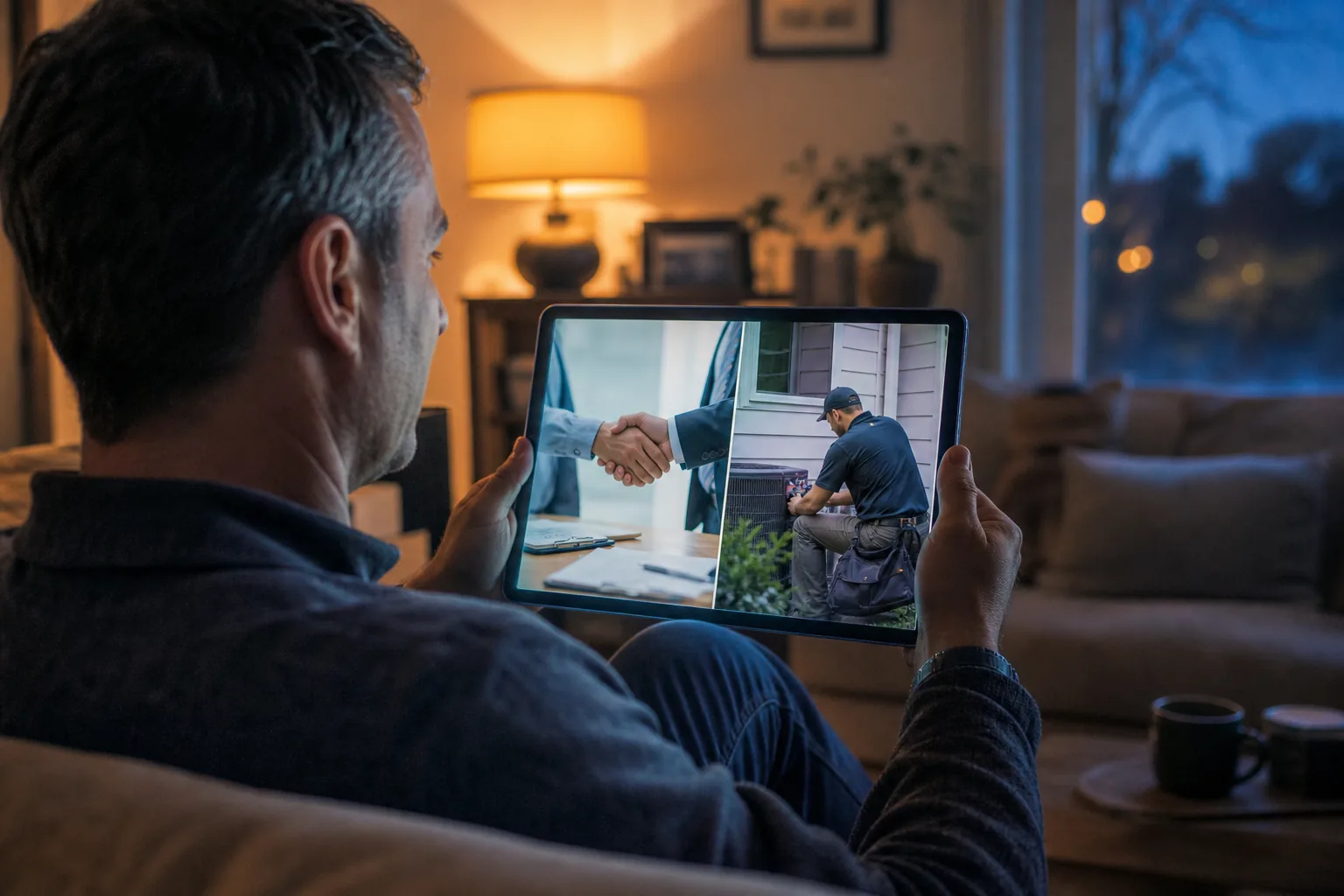
Stock photos aren’t proof. Neither are AI faces.
By Milad Nikaeen | 8 min read | August 20, 2026
Your homepage has a perfect van, a perfect kitchen, and a technician with perfect teeth. None of them have ever been on your job.
That is the stills version of the leak in Why your marketing isn’t working — proof that does not prove anything. If they never find you, start with the Maps listing. If they visit and bounce, that is the trust gap. If you already paid for a film, read pretty videos aren’t ROI. If they inquire and go cold, that is speed-to-lead, not a better stock library. This article is for the owner whose site looks “professional” and still does not get the call.
Buyers do not study your hero image. They skip it.
Nielsen Norman Group’s eyetracking work is blunt. In Photos as Web Content, Jakob Nielsen found users pay close attention to pictures that carry information — products, real people, real work — and ignore fluffy pictures used to “jazz up” a page. Stock photos of generic people sit in the ignore pile. Their later piece on trustworthy web design is even more specific for services: when people evaluate a cleaner, they want the process and the person who will enter the house, not a magazine shot of an already-spotless room.
A handshake in a glass lobby does not answer “will this crew show up at my house.” It answers “this template came with a free image.”
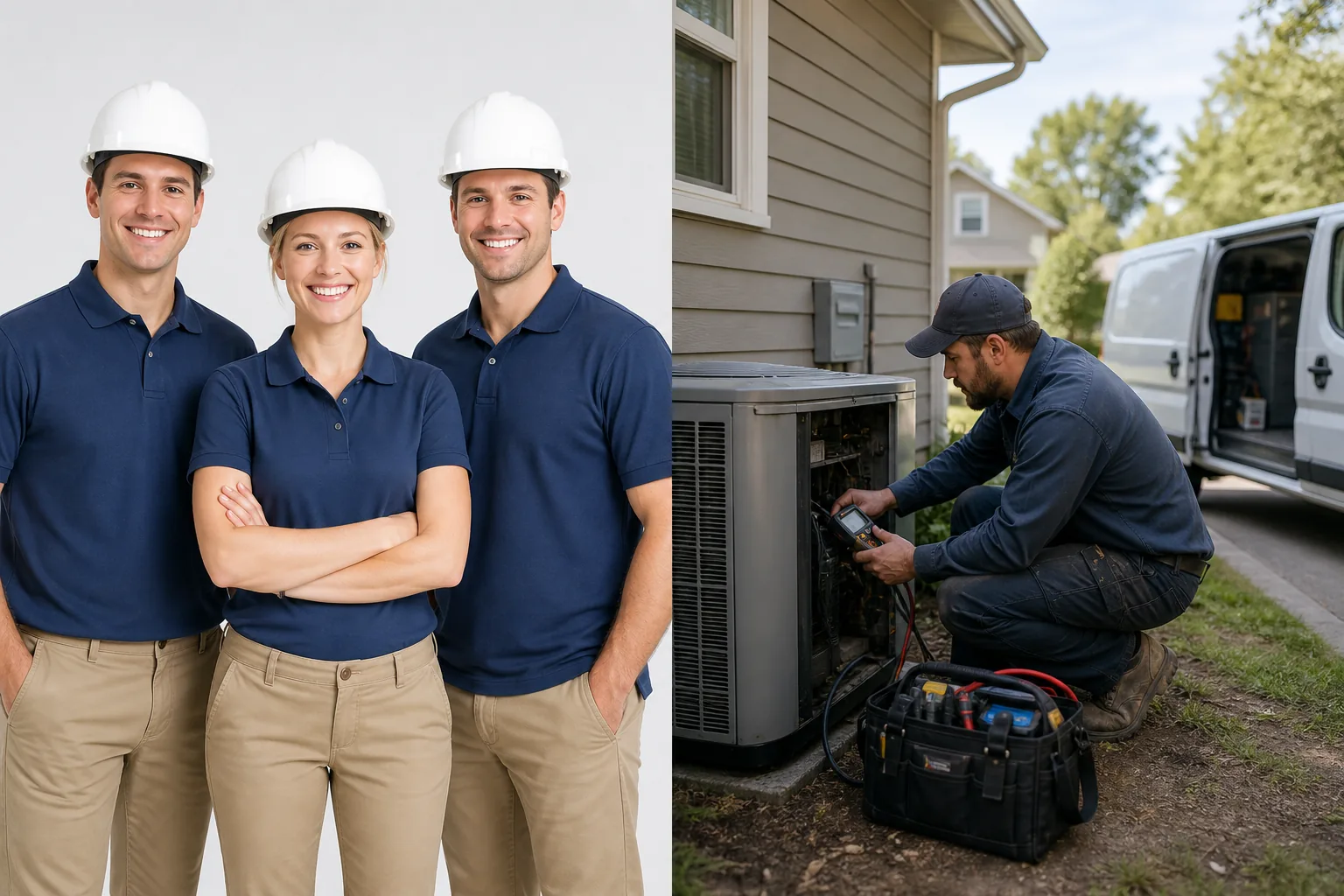
Authentic is the trust word. AI people are the opposite.
Getty Images’ April 2024 VisualGPS report, Building Trust in the Age of AI (four surveys of adults 18+, 7,500 per wave, 25 countries, July 2022–September 2023), found 98% of consumers agree authentic images and videos are pivotal to establishing trust. Almost 90% want to know whether an image was created with AI. 76% already say they cannot tell if an image is real. People feel less favorably toward brands that use AI-generated visuals to create people or products. Where trust is the job, Getty’s own guidance is to prefer pre-shot content.
That is a stock-and-AI company telling you not to fake the proof. For a plumber, a clinic, or a renovation crew, the proof is the people and the product of the work.
Google’s rule is one sentence: represent reality
Google’s help for business-specific photos is not a mood board. Photos should be in focus, well lit, and have no significant alterations or excessive use of filters or AI. “In other words, the image should represent reality.” They ask for at least three exterior shots, three interiors if you have a place, three photos of the team at work, and three team photos. A stock van from another continent fails that test twice: it is not your business, and it is not reality.
BrightLocal’s July 2026 study, What makes consumers choose your business? (1,227 US consumers who had searched for a local business in the last three months), puts photos on the shortlist. During research, 24% said photos of the business or its work influenced them — tied with category. When they decided who to contact, 18% named “the best photos.” 16% skipped a business because the listing had no photos. A professional-looking website mattered to 20%. Stock does not make you look professional. It makes you look interchangeable.
Google’s official walkthrough for adding those photos:
Google Help — add and manage photos and videos on your Business Profile (watch on YouTube)
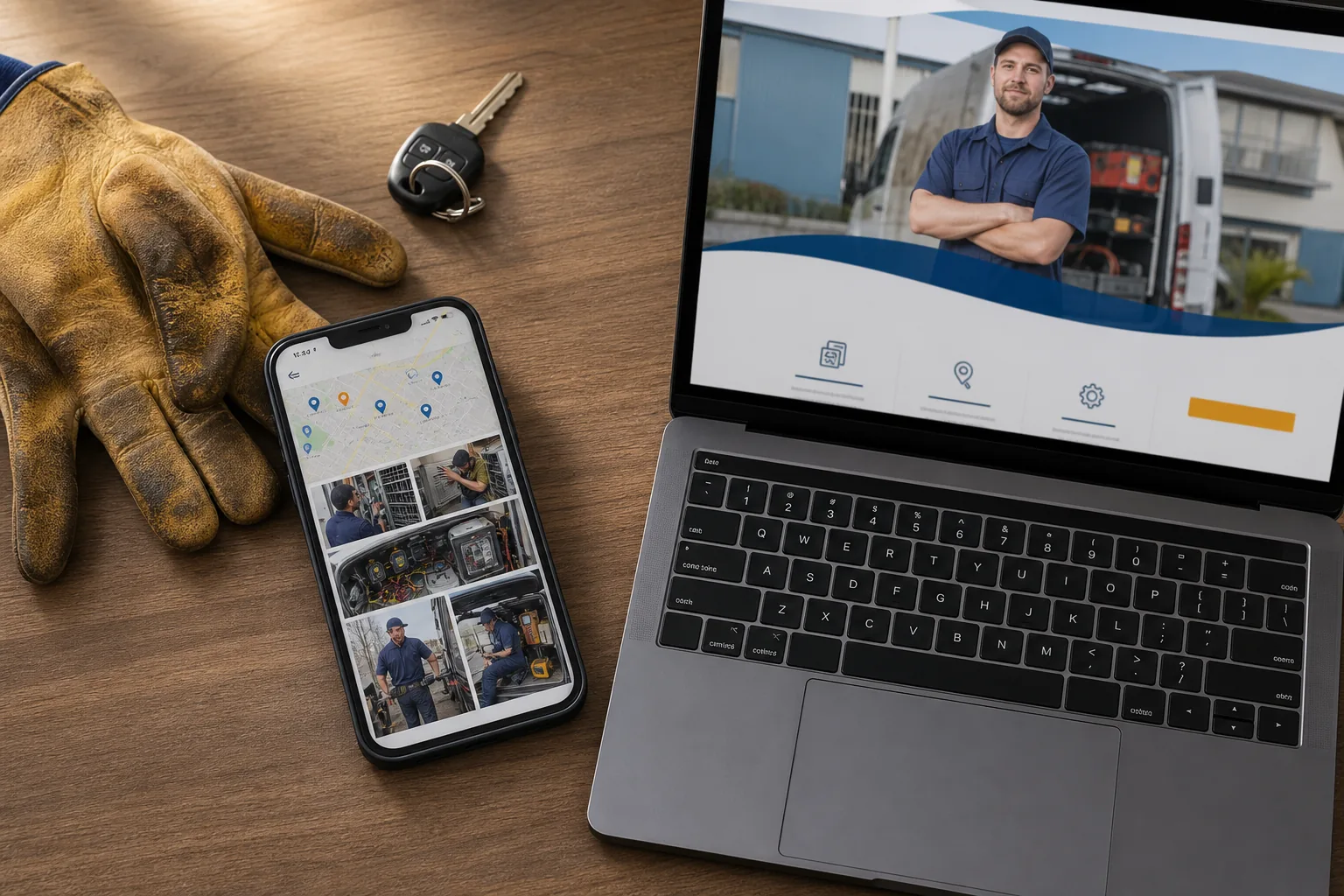
Where fake visuals actually leak revenue
1. The hero is a costume
If the first screen could belong to any contractor in North America, you have a strategy problem wearing a photography problem. Brand Strategy is who you help and what you refuse. The photo has to match that sentence — this neighbourhood, this van, this kind of job.
2. The “team” page is a library search
NN/g’s finding still holds: real staff photos get looked at. Generic models get skipped. An AI face is worse than stock — Getty found sentiment turns negative when AI invents people. Do not generate a crew you do not have. Photograph the people who will walk in the door, even if that is one owner and a helper.
3. You generated a job that never happened
A Midjourney “finished basement” is not a portfolio. It is a claim. Service buyers compare it to the neighbour’s real before-and-after. Creative Production is the stills and the film of the actual work — the companion to video that converts, not a replacement for it.
4. The photos work. Nobody answers.
Proof that generates a form you return tomorrow is still a leak. That is WealSmart CRM and the 5-minute rule. An AI writer in the van does not count — ChatGPT is not an AI agent. Do not shoot a better gallery so you can ignore the phone.
A 15-minute photo audit (before you hire a drone)
- Reverse-look your homepage hero. If it could be anyone’s van, replace it. Same test for the About page.
- Open your Google Business Profile as a stranger. Count real job photos vs logos vs stock. Google wants work-in-progress and team shots that represent reality — see their photo guidelines.
- Match Maps to the site. Same crew, same neighbourhood, same offer. A stock hero next to real Maps photos is a trust contradiction.
- Ban AI people and AI finished jobs from any page that is supposed to prove you did the work. Use AI for layouts and concepts if you want. Not for evidence.
- Then take the growth plan so the next dollar goes to strategy, a real shoot, or follow-up — not another stock subscription.
If you want that sequence without guessing, use the five-step growth plan on the homepage. A few minutes. It maps your answers to Brand Strategy, Creative Production, or WealSmart CRM.
FAQ
Are stock photos ever OK?
For a blog illustration or an abstract diagram, maybe. For the hero, the team, the gallery, and Google Business Profile — no. Those slots are proof. NN/g found decorative stock gets ignored. Google asks photos to represent reality.
Is an AI technician on the homepage illegal?
This is not legal advice. It is a trust problem. Getty found people feel worse about brands that use AI to create people or products, and most already cannot tell real from fake. Google’s listing rules say skip excessive AI. Do not invent a crew.
What should I do first with WealWave?
Fill out the 5-step growth plan. If the leak is fake or missing proof, we start with Brand Strategy and Creative Production. If the photos already create inquiries, we start with WealSmart follow-up.