
ChatGPT is not an AI agent
By Milad Nikaeen | 8 min read | August 20, 2026
You used AI to write a caption. The lead who filled out the form still waited until tomorrow.
That is the follow-up leak in Why your marketing isn’t working — now wearing a chatbot sticker. If nobody finds you, start with the Maps listing. If they visit and bounce, that is the trust gap, a pretty video, or stock and AI faces. If they inquire and go cold, read the 5-minute rule. This article is for the owner who already “has AI” and still misses jobs.
The 2026 split: everyone has a writer. Almost nobody has an agent.
Constant Contact’s June 2026 Small Business Now study (5,000+ owners and consumers) found US small-business marketing AI adoption jumped from 26% in 2023 to 87% by April 2026. Half of users globally said the main win is saving time — mostly through content and data analysis. Their own stats roundup puts the jobs even more plainly: owners use AI to write copy and analyse data. That is a drafting assistant. It does not answer the phone.
Salesforce’s SMB takeaways from the 10th State of Marketing (4,450 marketers worldwide, April 2026) is the other half of the chart. Only 13% of marketers are using agentic AI — systems that take action on your behalf. High-performing teams are nearly twice as likely to use agents as underperformers. 80% of SMB marketers expect major or moderate ROI gains from agents. 52% say their current tools cannot handle two-way conversations at scale. 78% now trust AI to respond to inquiries. Buyers want a conversation. Most stacks still wait for the owner to finish a job.
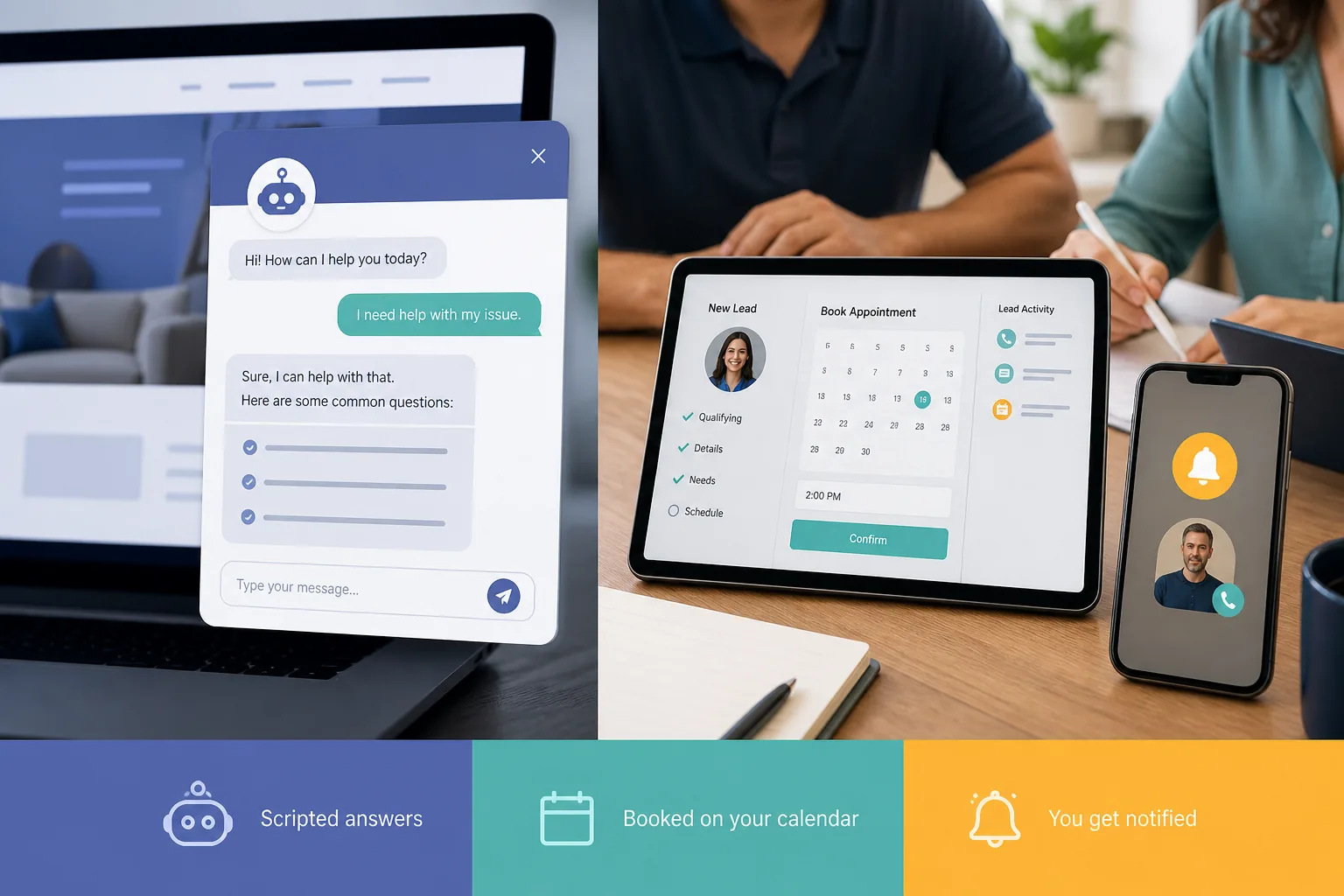
Assistants wait. Agents work.
HubSpot’s product team put it in one line: assistants help you do a task; agents do it for you. An assistant drafts a caption when you ask. An agent sees the form fill, sends the first text, logs the CRM, and pings you when a human is needed. Watch their walkthrough:
HubSpot — agents vs assistants: one waits for a prompt, the other completes the job (watch on YouTube)
Why “we bought an AI chatbot” usually fails
Gartner’s June 2025 forecast is the warning label: over 40% of agentic AI projects will be canceled by the end of 2027 — cost, unclear value, or weak controls. Their 2026 Hype Cycle still puts agentic AI at inflated expectations. For a service shop, that usually looks like a website widget that answers “what are your hours?” and cannot book the emergency, cannot text the owner, and cannot refuse a job outside the service area.
LocaliQ’s 2026 SMB trends report still finds most small teams running leads from the inbox. An agent with no CRM is a conversation that vanishes. That is why WealSmart CRM exists: the first reply in minutes, every lead visible, the owner only interrupted when a human is required. The playbook is speed-to-lead. AI without that job is a novelty.

1. The agent has nothing true to say
If the offer is “services for everyone,” the bot will invent confidence. Brand Strategy is the sentence the agent is allowed to promise — who you help, what you refuse, which towns, what happens next.
2. The proof is still a stock photo
A fluent reply on a generic page does not close a $8,000 job. Creative Production is the crew, the job, the neighbourhood. The agent can send the video. It cannot replace it. An AI face on the homepage is worse than silence — stock photos aren’t proof. If you want the sequence without guessing, take the five-step growth plan.
3. Nobody owns the handoff
An agent that never escalates is a liability. An agent that texts you for every “how much?” is still you. WealSmart’s job is the middle: auto-reply, capture, alert when they answer. You do the real work.
A 15-minute agent test (before you buy another tool)
- Name one job. First reply to a web form. Not “AI for the whole business.”
- Write the guardrails. Service area, what you never quote in chat, when a human must take over. That is strategy, not a prompt pack.
- Require a CRM record. If it is not logged, it did not happen. Inbox screenshots are not a system.
- Measure booked conversations, not chatbot sessions. Same test as video ROI: views are not jobs.
- Then take the growth plan so the next dollar goes to strategy, creative, or WealSmart — not another widget.
If you want that sequence without guessing, use the five-step growth plan on the homepage. A few minutes. It maps your answers to Brand Strategy, Creative Production, or WealSmart CRM.
FAQ
Is ChatGPT an AI agent?
No. It waits for you. An agent takes a defined job in your tools — reply, book, log, escalate — without you opening a tab first.
Should I add a chatbot to my website?
Not as a substitute for follow-up. A FAQ widget does not fix the 5-minute leak. Start with the inquiry that already arrives.
What should I do first with WealWave?
Fill out the 5-step growth plan. If the leak is follow-up, we start with WealSmart. If the agent would have nothing true to say, we start with Brand Strategy and Creative.